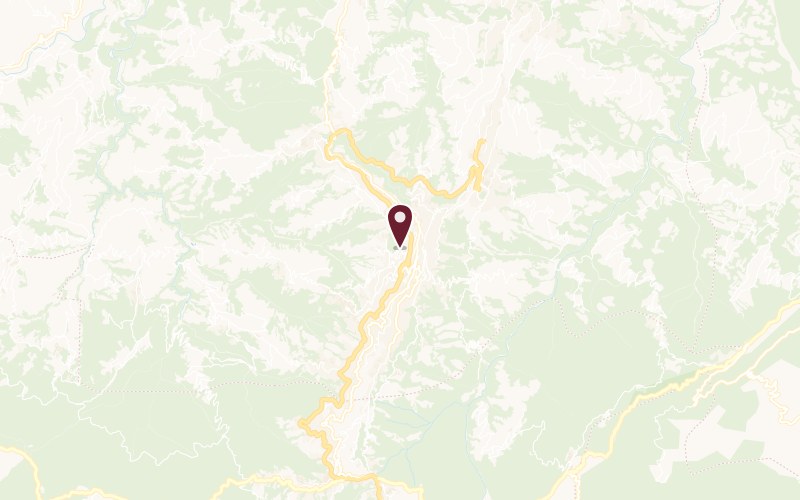
Tamyang Monastery
Darjeeling, India · c. 1950 – 1955
27.04320°N, 88.26370°E
Key Facts
- ◆ A Nyingma temple of the typical Nepalese pagoda type, built in the bazaar area by the Tamang community.
- ◆ Sangharakshita had never seen an image of Padmasambhava before entering this temple.
- ◆ He described the encounter as 'spiritually speaking, the climax of my entire visit' to Darjeeling.
- ◆ The figure was three or four times larger than life — the mighty, sedent form of the semi-legendary founder of the Nyingma tradition, holding a skull cup and a staff topped with skulls.
- ◆ Flanked by two consorts, one Tibetan and one Nepalese.
Darjeeling was thirty-two miles from Kalimpong by road — but only fifteen miles as the crow flies, across the great chasm of the River Teesta and up 8,000 feet through tropical jungle, tea gardens and pine forests to Ghoom. Having recovered from his habitual car sickness on the hairpin bends, Sangharakshita found Darjeeling much bigger than Kalimpong, and more definitively Nepalese in character.
In the bazaar area stood a Nyingma temple built by the Tamang community — of the typical Nepalese pagoda type. As he entered, he was wholly unprepared for what he found:
“I had never seen an image of Padmasambhava before, perhaps not even a painting. As I entered the temple, all the greater was the shock, therefore, when I saw in front of me, three or four times larger than life, the mighty sedent figure of the semi-legendary founder and inspirer of the Nyingma tradition, a skull cup in his left hand, a staff topped with skulls in the crook of his left arm, and the celebrated ‘wrathful smile’ on his moustached face. All this I took in instantly, together with the ‘lotus hat’, the richly embroidered robes, and the much smaller flanking figures of his two consorts, one Tibetan and one Nepalese.
Having taken it in, I felt that it had always been there, and that in seeing the figure of Padmasambhava I had become conscious of a spiritual presence that had in fact been with me all the time. Though I had never seen the figure of Padmasambhava before, it was familiar to me in a way that no other figure on earth was familiar: familiar and fascinating. It was familiar as my own self, yet at the same time infinitely mysterious, infinitely wonderful, and infinitely inspiring.”
From then on, the figure of Padmasambhava — Guru Rimpoche — occupied a permanent place in Sangharakshita’s inner spiritual world.
— In the Sign of the Golden Wheel
Source: In the Sign of the Golden Wheel
Other sites in Darjeeling
Contribute
Help keep this resource accurate and alive. You can leave a comment, suggest a correction, or submit a photo taken on your pilgrimage. All contributions are reviewed before publishing.
PUBLIC_WEB3FORMS_KEY in your environment variables.